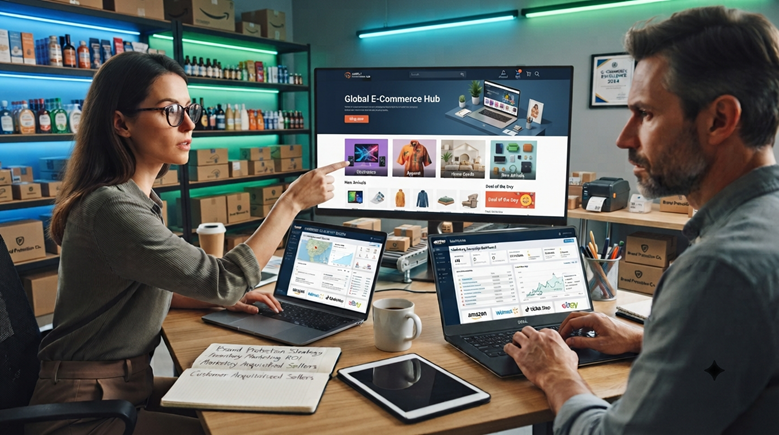
If your products are selling well online, there is a good chance people you never approved are profiting from them too — which is exactly why more brands are turning to dedicated reseller management software to take back control. Unauthorized sellers on marketplaces like Amazon, Walmart, TikTok Shop, and eBay can quietly erode your margins, your pricing, and the trust you have worked hard to build.
What Are Unauthorized Sellers?
Unauthorized sellers are third parties who list and sell your products without your permission. Their inventory often comes from diverted or “gray market” channels — bulk buyers, disgruntled distributors, or resellers who acquire stock and flip it on open marketplaces.
While not every unauthorized seller is peddling fakes, their presence strips away your control over pricing, presentation, and the customer experience. At worst, it opens the door to counterfeit goods slipping in alongside genuine stock. The challenge is compounded by how easy it has become to start selling: anyone with inventory and an account can list within minutes.
A Growing Problem in a Booming Marketplace
The sheer scale of online marketplaces makes this a serious challenge. According to Statista, third-party sellers accounted for roughly 61% of paid units sold on Amazon in late 2024, and industry trackers estimate close to two million active third-party sellers on the platform worldwide.
That vast, largely anonymous seller base is fertile ground for abuse. The problem also feeds a much larger illicit economy: the OECD and EUIPO estimate that global trade in counterfeit and pirated goods reached around $467 billion in 2021 — equivalent to 2.3% of all world imports — with e-commerce and small-parcel shipping increasingly used to move fakes.
Why Unauthorized Sellers Hurt Your Brand
The damage goes well beyond a few lost sales. Unauthorized sellers frequently undercut your Minimum Advertised Price (MAP), triggering price wars that erode margins across your entire authorized network.
They also compete for the “buy box” — the default purchase option on a listing — which can leave you paying for advertising that drives traffic straight to someone else’s offer. And because these sellers operate outside your standards, poor packaging, expired stock, or missing warranties reflect badly on your brand, not theirs.
There is a knock-on effect, too. When authorized retailers and distributors see their pricing repeatedly undercut by anonymous sellers, they lose confidence in the brand and may scale back their own orders, weakening the very partnerships that drive sustainable growth.
The Counterfeit Connection
Perhaps the greatest risk is reputational and, in some categories, physical. When unauthorized sellers proliferate, counterfeit and potentially unsafe products can follow, particularly in high-demand categories.
Marketplaces have invested heavily in response. Amazon, for example, has reported identifying and disposing of more than 15 million counterfeit products globally in a single year as part of its brand protection efforts. Yet even these programs are largely reactive, stepping in after a problem is reported rather than preventing it in the first place.
Why Marketplace Tools Aren’t Enough
Each platform has its own rules and enforcement mechanisms, but they share a common limitation: they generally act only once a violation is flagged. For a brand selling across Amazon, Walmart, TikTok Shop, and eBay at the same time, monitoring every listing by hand is simply impossible.
By the time a violation surfaces in a spreadsheet, the damage — lost buy box share, undercut pricing, frustrated retail partners — has often already been done. Proactive, continuous oversight is the only realistic way to stay ahead.
Building an Effective Enforcement Strategy
Regaining control takes a systematic approach. It begins with a clear authorized-reseller policy and legally sound reseller agreements, which give you the standing to act against violators.
From there, the essentials are continuous monitoring across every marketplace where your products appear, tracing the sources of inventory leakage so you can cut off supply at its root, and executing timely, well-documented enforcement to remove unauthorized listings. Pairing this with real-time MAP monitoring helps stabilize pricing before violations spread across channels.
Crucially, enforcement must rest on the right legal foundation. Well-drafted agreements and consistent, properly executed action are what make takedowns stick, rather than one-off complaints that sellers simply ignore.
Taking Back Control
Unauthorized sellers are not a nuisance to be tolerated; they are a direct threat to your revenue, your pricing integrity, and your customers’ trust. The brands that thrive are those that treat marketplace control as an ongoing discipline rather than an occasional cleanup. With automated monitoring, inventory-source tracing, and legal-grade enforcement across Amazon, Walmart, TikTok Shop, eBay, and hundreds of other marketplaces, i2o Retail helps brands turn a chaotic reseller landscape into a controlled, profitable channel — so if you are ready to protect both your margins and your reputation, investing in professional unauthorized seller enforcement is one of the smartest moves you can make.




Be First to Comment