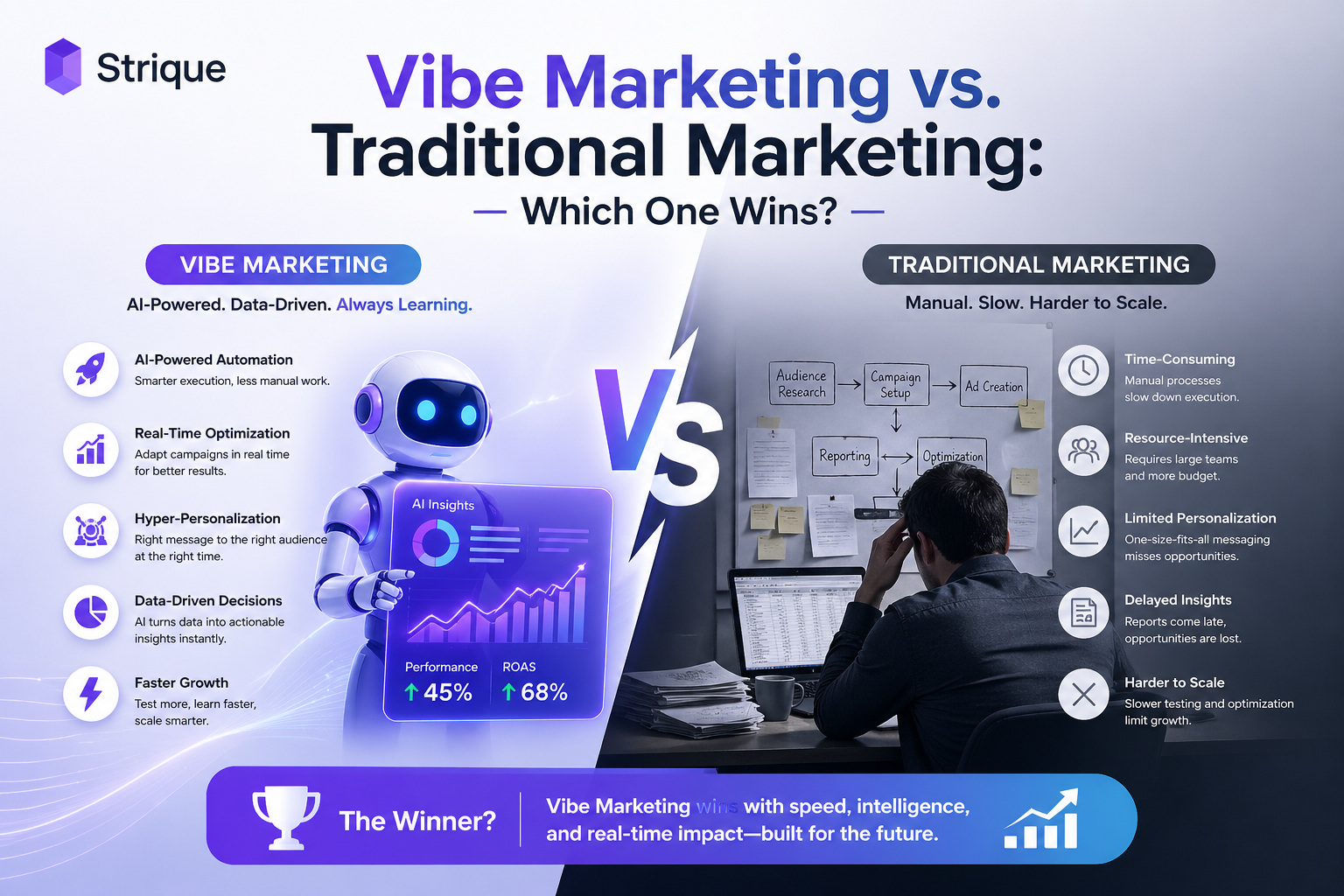
The current growth environment is evolving more quickly than before. AI-driven systems that learn and adapt in real time are challenging what previously worked with fixed campaign schedules, human optimization, and channel-based execution. For brands aiming for scalable growth, the argument between vibe marketing and traditional marketing is becoming more and more crucial.
A straightforward philosophical difference lies at the core of this change. While AI Vibe Marketing is based on intent, cues, and ongoing learning loops, traditional systems rely on predetermined routines. AI-driven technologies lower operational friction and free up teams to concentrate on strategy, experimentation, and consumer relevance rather than having marketers spend the majority of their time on repeated execution.
This is not about swapping out marketing principles, as Strique’s method makes clear. The goal is to develop them for a quicker digital world where quickness, flexibility, and wiser choices produce long-term benefits.
Understanding the Fundamental Distinction
It is helpful to first understand what vibe marketing is in order to accurately compare the two strategies. Vibe marketing is a prompt-driven, AI-first growth paradigm in which the marketer specifies the following:
- The campaign’s goal
- The intended audience
- The tone of the brand
- The conversion objective
- Budgetary reasoning
- Signals of performance
These strategy inputs are then transformed by AI into campaign structures, innovative recommendations, optimization routes, and reporting insights.
On the other hand, traditional marketing employs a more linear execution model:
- Manual search
- Setting up a campaign
- Segmenting audience
- Launch
- Reporting
- Optimization
Traditional processes are still helpful for long-term brand building, offline activations, and highly customized business campaigns among the various forms of marketing. However, vibe marketing offers more speed and iteration potential for performance-driven digital growth.
Where Traditional Marketing is Still Effective
Traditional marketing, also known as conventional marketing. It is by no means out of date. It continues to do well in the following areas:
- The richness of human stories is important.
- Careful cultivation of brand perception is necessary’
- There are significant offline campaigns.
- Automation is slowed by many permission layers.
- There are well-established historical brand systems.
For instance, traditional planning models continue to be beneficial for sponsorships of events, television, print, and experiential advertising. Process control, campaign sequencing, and long-term consistency are the marketer’s strongest points in these situations. For this reason, rather than completely switching to vibe-led systems, many organizations continue to integrate traditional campaign frameworks with traditional AI marketing support technologies.
Why Vibe Marketing Succeeds in Growth that Prioritises Digital
Customer behavior is always evolving in the digital world. Systems that can react quickly are necessary due to creative fatigue, bid fluctuations, platform learning, and shifting audience intent. At this point, the dispute between vibe marketing and traditional marketing becomes more of a performance reality. Today’s vibe: marketers don’t have to spend hours manually copying ad packages or extracting dashboards. Rather, they concentrate on providing the AI system with more precise strategy cues. This permits:
- Quicker A/B testing
- Faster audience turns
- Changes in the budget in real time
- Testing landing ages
- More innovative iteration
- Predictive insights at the campaign level
Automation is not the only benefit; it’s a clever adaptation. By transforming fragmented data into a real-time decision system, AI marketing performs better in this situation than static workflow.
AI’s Impact on Campaign Decision-Making
The main reason why marketing frequently succeeds is that it alters decision-making. Delayed reporting periods are a major component of traditional marketing. After crucial time has already elapsed, the team evaluates outcomes, builds decks, and makes adjustments. Decision loops are shortened using AI Vibe Marketing. AI systems are able to analyze:
- A decreased CTR
- Audience decline
- Inefficient spending
- Funnel friction
- Fatigue from creativity
- Trends at the produce level
An AI tool for vibe marketing becomes very effective in this situation. Rather than just displaying dashboards, the tool can suggest:
- Exclusion from the audience.
- New Hooks
- Changes in artistic direction
- Reallocation of funds
- Remarkable improvement
- Messaging during the funnel stage
- Campaign management becomes proactive instead of reactive at speed.
Which Model is Best for Modern Brands
The response is dependent upon corporate objectives. Traditional marketing still has significant benefits if the objective is high-control brand campaigns, mass awareness, or long-cycle narratives. However, if the goal is:
- Improvement in performance
- Attribution via several channels
- Quick experimenting
- Reduced CAC
- A quicker scale
When a team is efficient, vibe marketing frequently prevails. Campaign learning speed has a direct impact on profitability, particularly for D2C, SaaS, marketplaces, and performance-first customer businesses. The strongest brands today are not choosing one over the other completely. Rather, they integrate AI-driven execution layers with traditional systems’ strategic foundations. This hybrid strategy provides companies with:
- Human ingenuity
- Organized brand thinking
- Quick execution of AI
- More robust interpretation of data
- Quicker loops for consumer feedback
What is the winner of the Vibe Marketing vs. Traditional Marketing debate?
Vibe marketing is superior for modern digital growth since it substitutes intelligent, adaptable solutions for sluggish operational workflows. It enables marketers to concentrate more on client intent, experimentation, and strategy clarity than on routine execution. For regulated campaign worlds and long-form brand storytelling, traditional approaches are still useful. However, AI Vibe Marketing gives organizations the flexibility they need to remain competitive in a rapidly evolving digital ecosystem.
The way Strique transforms vibe marketing into a useful growth engine is what makes this change even more potent. Striique integrates campaign information, creative analysis, and performance suggestions into a single AI-driven process. Saving marketers from having disjointed dashboards and prolonged optimization cycles. In addition to quicker execution, the goal is to assist brands in lowering uncertainty, increasing ROAS, and making more informed real-time budget decisions. This type of unified AI marketing solution makes vibe marketing significantly more actionable than traditional marketing for organizations scaling across Meta, Google, and D2C channels.
The marketer who understands when to blend classic strategy with AI-driven speed is the true victor, not just one model. The future of saleable growth is determined by this balance.
FAQs
1. What is the difference between vibe marketing and traditional marketing?
The main difference is speed and adaptability. Traditional marketing relies on manual workflows, while vibe marketing uses AI-led systems to optimise campaigns faster.
2. What is vibe marketing in simple words?
What Is Vibe Marketing refers to an AI-first growth model where marketers provide goals and context, while AI helps execute campaigns and optimise performance.
3. Can traditional marketing still work today?
Yes, it remains effective for offline campaigns, storytelling-led branding and long approval-based campaign structures.
4. What AI tool for vibe marketing is most useful?
The best AI Tool For Vibe Marketing is one that combines campaign analytics, creative recommendations and predictive optimisation in one workflow.
5. Who is a vibe marketer?
A Vibe Marketer is a strategist who guides AI systems using prompts, performance goals and customer insights to drive smarter growth decisions.


Be First to Comment