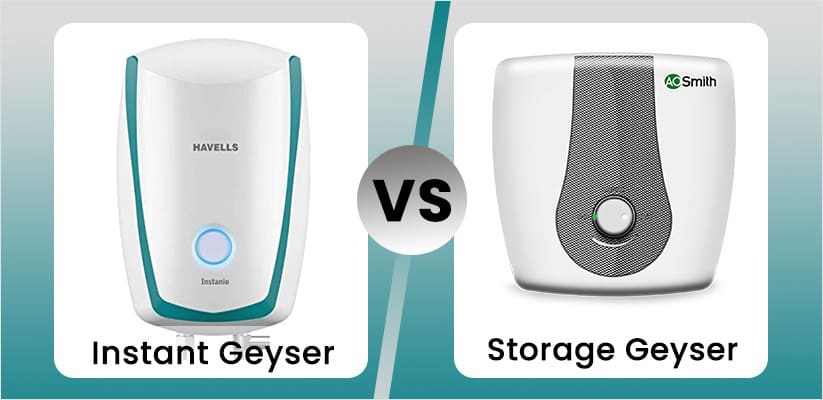
Hot water feels great on a cold morning, but the electricity bill may not. A geyser uses a lot of power quickly, so knowing its cost helps you plan your monthly budget.
Electrical geysers come in two main types: instant and storage. Each uses power differently, so each adds a different amount to your bill.
Let’s find out which one fits your budget without compromising your hot water supply.
How a Geyser Uses Electricity
- Power Rating: Every geyser has a wattage rating on its label. It shows how much power the heater pulls while working. Instant types are usually 3,000 to 4,500 watts, while storage types are usually about 2,000 watts.
- Running Time: Electrical geysers cost money only while they heat, so your bill depends on how long the heater stays on. An instant geyser pulls more power but runs for a few minutes. A storage heater runs much longer.
- Standing Loss: A storage tank slowly loses heat, even when nobody uses hot water. The heater then switches on again to keep the water warm. This extra use is called standing loss, and instant types have almost none.
How to Estimate Your Bill in 3 Steps
Calculating the cost of electrical geysers is easier than it sounds. You only need three things: the heater’s watts, the hours it runs and your price per unit. One unit means one kilowatt used for one hour.
Step 1: Find units
Divide the watts by 1,000, then multiply by the hours the geyser runs. A 3,000-watt heater is 3 kW, and running it for 10 minutes (one-sixth of an hour) comes to 0.5 units. Do the same sum for each time you use it.
Step 2: Multiply by 30
Take the units used in a day and multiply by 30 to get the month. If one bath uses 0.5 units, a daily bath for a month uses 15 units. Repeat this for each person in the house.
Step 3: Multiply by your rate
Your electricity bill shows the price per unit. These examples use INR 8, so 15 units a month costs INR 120. Your rate may be higher or lower, so check the bill before you start.
Instant Geyser: Bill Estimate
- One bath: A 3,000-watt instant geyser running for 10 minutes uses 0.5 units, which costs about INR 4. A 4,500-watt model uses 0.75 units, or about INR 6. Longer baths cost more, so 20 minutes of heating doubles the sum.
- Monthly range: For a family that bathes daily, most homes see about INR 150 to INR 500 extra each month. The exact figure depends on watts, water temperature, and how many people use hot water. Kitchen use adds a little.
- Buying cost: Instant geysers are small and simple, so they usually cost less. Some variants with a capacity of three litres begin at around INR 4,000. Verify current listings before buying, since prices change based on the brand and offers.
Storage Geyser: Bill Estimate
Daily use: It takes about 2 units to heat 50 litres of water from 20°C to 55°C in a stored geyser. That’s about 2.5 units a day, or 76 units a month, plus about half a unit for standing loss.
Monthly cost: At about INR 7.50 a unit, a star-rated storage tank costs roughly INR 555 to INR 80 a month for 50 litres of hot water daily. An instant heater doing the same job costs only about INR 460.
Easy Ways to Cut Your Geyser Bill
- Lower the temperature: Most people are happy with warm water, not very hot water. Adjust your geyser to a lower setting, especially during the colder months when the heater is already working harder. Even small adjustments can make a big difference over a month.
- Switch off after use: Turn the heater off once your bucket is full or your bath is done. Leaving a storage tank on can add 40 to 90 extra units in winter. That cost is easy to avoid.
- Use a timer: A simple timer or smart plug turns the heater on just before you need it and off soon after. Electrical geysers work well with this habit, and it stops forgotten heating without any extra effort.
- Pick a better star rating: A higher BEE star rating means less heat loss for the same water. It can raise the geyser price a little, but it saves power every month. Even instant types carry star ratings.
Instant vs Storage: Which Costs Less?
- Small family or light use: If one or two people use hot water briefly, an instant geyser usually costs less. No heat is lost to standing, and it warms only what you need. In the background, nothing is warmly maintained.
- Big family or heavy use: When many people bathe back to back, a well-insulated tank can come closer in cost. This prevents you from having to restart a high-power element repeatedly. Because the sources differ, your personal habits matter most.
Think about buying cost too: Storage models often cost more upfront, sometimes starting near INR 11,500 for 10 litres on one maker’s page. This price gap can often determine how much modest families save on a regular basis.
Conclusion
Instant heaters usually cost less to run for light use, while storage heaters suit busy homes with many users.
Both options are correct. What matters is how much hot water you use each day. To get an accurate picture of your actual cost, use the three-step total with your own watts and rate. Small routines might add up to significant savings over time. Then pick the geyser that fits your family, your space and your budget.




Be First to Comment