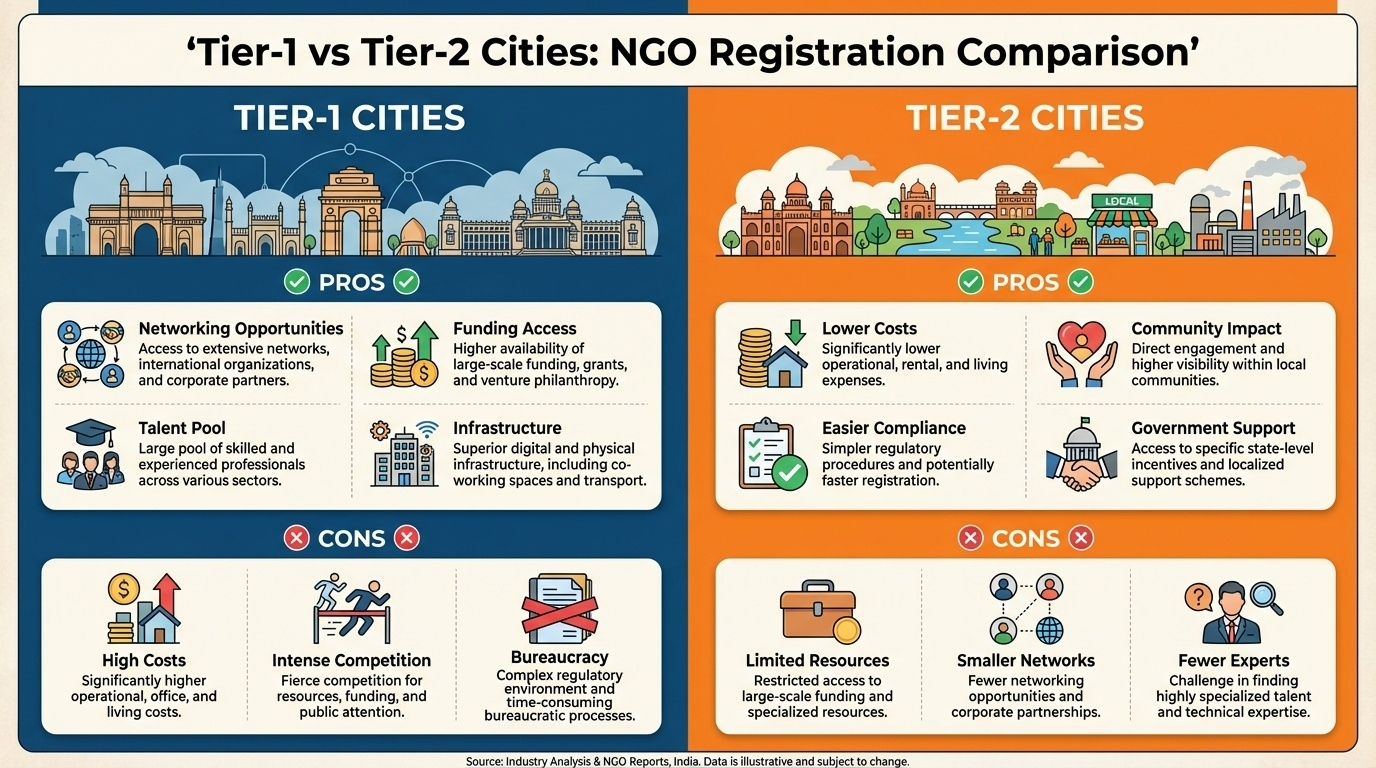
Starting an NGO in India is a significant step towards social impact, but one of the earliest challenges founders face is deciding on the best state to register in. This choice affects legal compliance, operational costs, and access to funding, including CSR partnerships and foreign donations. If you choose the wrong state without understanding the nuances, your NGO might face avoidable hurdles, delays, and expenses. However, the best state for registering an NGO in India depends on legal ease, government support, and cost factors. States like Delhi, Maharashtra (Mumbai), Karnataka (Bengaluru), and Tamil Nadu (Chennai) offer streamlined procedures, reasonable fees, and better access to CSR and FCRA approvals. Tier-2 cities like Pune and Coimbatore can also be cost-effective alternatives, given their growing NGO ecosystems.
By the end of this guest post, you will understand how state-specific factors influence NGO registration, ongoing compliance, and operational efficiency. You will also learn practical considerations based on real-world Indian contexts to choose the best state for your NGO’s registration.
Understanding the Legal Landscape for NGO Registration in India
When registering an NGO, you typically choose among three legal forms under Indian law:
-Society Registration (Societies Registration Act, 1860)
-Trust Registration (Indian Trusts Act, 1882)
– Section 8 Company (Companies Act, 2013)
Each legal form has different registration authorities and compliance requirements, which can vary slightly by state.
Key Laws for the Authorities to Know
- Societies: Register with the Registrar of Societies in the respective state.
- Trusts: Register with the local Registrar of Trusts or Charity Commissioner.
- Section 8 Companies: Register with the Ministry of Corporate Affairs (MCA), a central authority, but state of registration matters for operational address and local compliance.
Additionally, NGOs aiming for tax benefits must apply for 12A and 80G registrations under the Income Tax Act, which are central but require proper state-level documentation.
For foreign funding, the FCRA (Foreign Contribution Regulation Act) registration is crucial and centrally governed, but the NGO’s registered state affects documentation and police verification processes.
Step-by-Step: How State Choice Impacts NGO Registration
1. Registration Process and Legal Ease
- Delhi: With an expert Registrar for Section 8 companies and a well-connected NGO community, the capital’s setup ensures that your regulatory approvals move at the speed of your impact.
- Mumbai (Maharashtra): With its high-volume networking and offering robust support infrastructure, Maharashtra is known for stringent but transparent compliance.
- Bengaluru (Karnataka): A growing NGO ecosystem with tech-driven government portals making registration smoother.
- Chennai (Tamil Nadu): Regarded for its moderate timelines, with a reputation for strict adherence to rules but supportive local authorities.
- Pune and Coimbatore (Tier-2): Known for their less crowded registries, lower fees, and faster processing times. However, CSR and funding opportunities might be comparatively fewer.
2. Registration Cost Variations
State governments set registration fees, which can vary significantly:
– Delhi and Maharashtra have moderate fees but higher incidental costs (e.g., notarization, legal consultations).
– Tamil Nadu offers relatively low registration fees for societies and trusts.
– Tier-2 cities often have the lowest fees, but watch for hidden administrative delays.
3. Compliance and Reporting
Ongoing compliance also depends on the state:
- States with digital filing systems (like Karnataka and Maharashtra) ease annual returns and audit submissions.
- Some states require more frequent local filings or police verifications, especially for FCRA and 12A/80G renewals.
4. Access to CSR and FCRA Benefits
– CSR funding is often concentrated in Tier-1 cities like Mumbai, Delhi, Bengaluru, and Chennai due to the presence of corporates. Registering your NGO in these cities can improve visibility and trust with CSR teams.
– FCRA approvals consider the NGO’s registered address; states with transparent and timely police verification processes (Delhi, Karnataka) often see smoother FCRA clearances.
Common Mistakes NGOs Make When Choosing a State
- Choosing based solely on cost: Low registration fees in Tier-2 cities can be attractive, but may limit access to CSR funds and foreign donations.
- Ignoring local compliance nuances: Some states require additional local registrations or affidavits that can delay operations.
- Not considering operational presence: Registering in a state different from where you operate can complicate legal processes, tax filings, and audits.
- Overlooking the impact on FCRA: FCRA renewals involve local police verification; states with slow processes can cause delays and funding interruptions.
Practical Checklist for Choosing the Best State for NGO Registration
– Confirm if your NGO’s main operational area aligns with the state of registration.
– Check the state Registrar’s efficiency and digital capabilities.
– Compare registration fees and incidental costs (stamp duty, notary).
– Evaluate local compliance requirements beyond registration (annual filings, audits).
– Consider CSR funding opportunities and presence of corporates in the state.
– Understand FCRA police verification timelines and processes in the state.
Consultant Insights from Real Cases
– An NGO founder registering in Delhi found faster 12A and FCRA approvals due to better government coordination, which helped in securing early funding.
– NGOs registering in Mumbai sometimes face longer wait times but benefit from a mature CSR network, which leads to larger grants.
– A Bengaluru-based NGO leveraged Karnataka’s online portal for societies, cutting registration time by nearly 30%.
– A trust registered in Coimbatore saved on costs but later had to register a branch in Chennai to access CSR opportunities efficiently.
If This Feels Confusing, consult with a compliance expert from our NGOExperts who understands both local and central NGO laws.
Frequently Asked Questions (FAQs)
Q1: Can I register my NGO in one state and operate in another?
Yes, but it complicates compliance and may delay funding approvals like FCRA.
Q2: Is the registration fee refundable if I cancel the NGO?
No, registration fees are generally non-refundable.
Q3: How long does NGO registration take in Delhi compared to Mumbai?
Delhi registrations typically take 15–30 days; Mumbai may take 30–45 days, depending on workload.
Q4: Does registering as a Section 8 company offer better CSR funding?
Section 8 companies are often preferred by corporates but have stricter compliance than societies or trusts.
Q5: Can tier-2 cities offer equal access to foreign funding?**
Access is possible but may require extra effort to build credibility and connections.
Conclusion
Choosing the best state for registering your NGO is not just a legal formality; it shapes your NGO’s compliance ease, cost efficiency, and funding potential. Delhi, Mumbai, Bengaluru, and Chennai lead in legal process transparency and CSR opportunities, while tier-2 cities like Pune and Coimbatore offer cost advantages with some trade-offs.
If you find the options overwhelming, consulting an expert familiar with Indian NGO laws and state affairs can make your decision straightforward and secure.
—
Need Help Choosing the Best State for Your NGO Registration?
If you want clarity on which state aligns best with your NGO’s mission and compliance needs, consider a tailored consultation. Understanding the legal ease, costs, and benefits upfront can save time and avoid costly mistakes.
Contact NGOExperts for practical guidance on NGO registration across India’s states—let’s make your NGO’s foundation strong and compliant from day one.





Be First to Comment