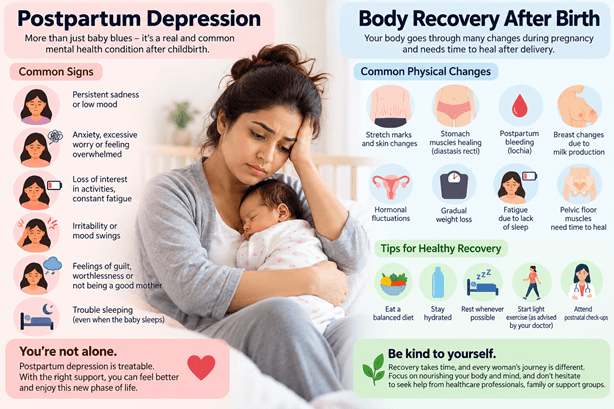
A first-time mother in Hyderabad told her sister six weeks after delivery that she had not showered in three days. Not because she was lazy. Because every time she stood up, she leaked. Urine, lochia, sometimes both. The walk from bed to bathroom felt like a negotiation with her own body, and most days her body won. She would sit back down, change the pad that was already soaking through, and cry. Not from pain. From the feeling that she had lost control of something fundamental.
Her doctor had talked about postpartum depression during a routine checkup. A separate conversation, clinical, focused on mood. Nobody connected it to the fact that her physical discomfort was feeding her mental collapse in real time. That gap in how we discuss postpartum recovery costs women weeks of suffering that could have been managed.
The Physical Mess Nobody Prepares You For
Lochia alone lasts four to six weeks. Heavy bleeding for the first ten days, tapering gradually. On top of that, roughly one in three women experiences urinary incontinence after vaginal delivery. Stress incontinence, specifically. You cough, you leak. You pick up the baby, you leak. You laugh at something your mother said and suddenly your underwear is wet.
Maternity pads handle lochia. They do not handle the combination of lochia and urinary leakage simultaneously. They are not built for that. So you are layering products, changing constantly, and still feeling damp.
Incontinence diapers for postpartum recovery solve that layering problem. One product handles both. You feel dry. You stop dreading every cough. A women adult diaper designed for postpartum flow gives you something that sounds small but is not: four hours without thinking about whether you are leaking.
PPD Does Not Happen in a Vacuum. Your Body Is Talking to Your Brain.
Here is what frustrates me about how postpartum depression gets discussed. It is almost always framed as a hormonal or psychological event. Like it floats above the physical experience. It does not.
A woman who has not slept more than ninety minutes at a stretch. Who feels wet and uncomfortable every time she moves. Who cannot pick up her baby without worrying about leaking. Who has stopped wanting visitors because she does not feel clean. That woman is not just hormonally vulnerable to depression. Her daily physical experience is actively pushing her toward it.
Studies estimate that 15 to 20% of new mothers experience PPD. I would bet money that the number is higher among women dealing with unmanaged incontinence. Nobody has funded that specific study yet, but any postpartum nurse will tell you the correlation is obvious.
Why “Feeling Clean” Is Not a Small Thing
I have heard women describe the moment they switched to a proper women adult diaper after delivery as the first time they felt like themselves again. That sounds dramatic. It is not.
Think about what constant dampness does to your mental state over days. Not hours. Days. You stop trusting your body. You start declining visitors. You avoid picking up the baby in certain positions. You shower less because the process of getting undressed, cleaning up, and re-layering products feels exhausting. Each of those small withdrawals feeds PPD directly.
A women adult diaper that actually holds both lochia and urine for several hours changes the math completely. You shower because you can. You sit with the baby on the couch because you are not worried about the cushion. You say yes when your friend asks to visit because you feel clean. You sleep for a stretch without waking up damp.
Pelvic Floor Recovery Runs Parallel. Do Not Skip It.
Incontinence after delivery is common. But common does not mean permanent, and this is where a lot of women get stuck. They assume the leaking will resolve on its own. For some women it does. For many, it lingers for months because the pelvic floor muscles need deliberate rehabilitation.
Kegel exercises. Start gentle. Five-second holds, ten reps, twice a day. Your body just went through something enormous so do not expect results in the first week. By week three or four, most women notice fewer leaks. By week eight to ten, many have regained enough control to step down from a women adult diaper to a lighter pad.
The products carry you while the muscles rebuild. That is their role. Not a permanent fixture. A bridge between where your body is and where it is heading.
Conclusion
We tell new mothers to rest. To accept help. To watch for signs of PPD. All good advice. But we almost never say this: your physical comfort in weeks one through six directly affects your mental recovery. A women adult diaper, a proper support garment, a pelvic floor exercise routine. These are not luxury add-ons. They are front-line tools against the combination of physical breakdown and emotional free fall that defines early postpartum for millions of women.



Be First to Comment