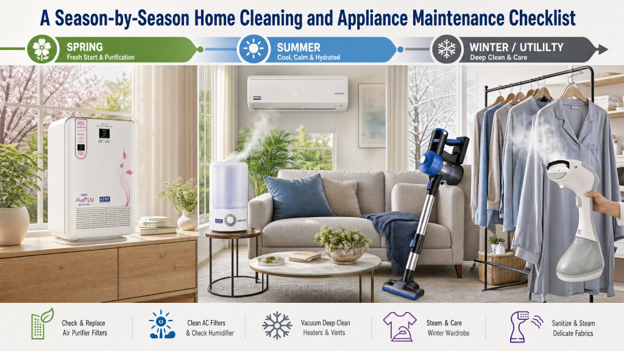
Routine cleaning does not always reach every part of the home. Dust may remain beneath furniture, residue can collect around appliance vents, and a humidifier tank may still hold water after use. If overlooked for long, these areas of your home may require more effort later and can affect the durability of your appliance.
A seasonal checklist divides this work into manageable tasks. It also helps families to understand which home appliances need attention as weather conditions and household routines change. Let’s begin with spring, when settled dust often becomes more noticeable around the home.
Spring: Clear Settled Dust and Pollen
Spring cleaning should reach the dust that settles beneath furniture, along room edges, and on surfaces often missed during routine maintenance tasks. A thorough spring clean also allows vacuum cleaners and air purifiers to support regular upkeep more effectively.
Spring Cleaning Checklist For a Spotless Home
Begin your spring cleaning by working through these tasks:
- Work from higher surfaces down: Wipe fan blades, shelves, door frames, and curtain rods before cleaning the floor. This prevents fallen dust from settling on an area that has already been cleaned.
- Reach beneath movable furniture: Shift the lighter chairs and tables aside, then get the vacuum into skirting boards, sofa edges, and the narrow gaps a broom usually misses.
- Clean entrance areas: Shake out or vacuum doormats and wipe window tracks. These areas often collect outdoor dust before it spreads further inside.
- Schedule routine floor cleaning: After the deeper clean, you can use robot vacuums for regular and effective floor mopping. If you are looking for reliable technology, use the KENT RoboKlean R1[1] Robot Vacuum Cleaner, which uses laser-based LDS navigation to map the room and cover the floor systematically. You can also use the KENT Service App for scheduling, cleaning and managing the appliance remotely.
- Manage pollen allergies with air filtration: Indoor air purification helps households deal with pollen and seasonal allergies that are common in the spring. An appropriately sized air purifier for home can filter particles suspended in the room. The KENT Alps+ UV Air Purifier, for instance, runs indoor air through a primary filter, an activated carbon filter, and an antibacterial HEPA filter, then through a UV LED for an extra layer of filtration. Featuring an air-quality monitor and filter-change indicator, it helps families track indoor conditions and when maintenance is required.
Once you clean a room with these smart appliances, keep them in the right working condition for optimal use. Here’s what you need to do:
Checklist for Appliance Care and Maintenance
After cleaning the room, inspect and maintain the appliances used throughout the process. Here’s how you can do it:
- Empty the robotic vacuum’s dustbin after each cleaning cycle
- Remove entangled hair and thread from its brushes and wheels
- Wipe navigation sensors with a clean, dry cloth
- Inspect the vacuum filter and clean or replace it according to the user manual
- Check the air purifier’s filter indicator rather than waiting for airflow to weaken
- Wipe the purifier’s exterior and keep its air inlet and outlet unobstructed
With spring dust and pollen addressed, summer maintenance focuses on cooling appliances and moisture levels inside frequently air-conditioned rooms.
Summer: Clean Indoor Areas and Check Room Humidity
Air conditioners tend to run longer in the summer and can also reduce indoor humidity while cooling the room. An ultrasonic humidifier helps maintain indoor moisture levels and reduce the dryness caused by air conditioners. When used with other household appliances like vacuum cleaners, it can make your summer home cleaning more effective:
Home Cleaning Checklist For Summers
Follow this checklist to address the areas that need greater attention during the summer months:
- Before cleaning, switch appliances off: Unplug fans and cooling appliances, then wipe down those outer surfaces the manual says are safe to clean.
- Clean around air-conditioner vents: Remove settled dust from the surrounding wall and accessible vent surfaces. Arrange professional servicing for internal components when required.
- Summer furnishings need a wash too: Bedding, cushion covers, and washable curtains should follow their care labels and shouldn’t go back into use until fully dry.
- Vacuum areas exposed by moved furniture: Summer rearrangements may reveal dust beneath beds, side tables, or cooling appliances. Vacuum those areas properly. You can use the KENT Duster Vacuum [2] Cleaner, as its 2-in-1 crevice nozzle reaches areas like curtains, sofas and carpets that are difficult to clean.
- Use a humidifier to balance moisture levels indoors: Constant running of air conditioners can make the room dry. Use a humidifier to balance moisture levels. For optimal indoor temperature, install the KENT Dew Ultrasonic Humidifier[3] . It uses ultrasonic fine mist and includes UV LED purification, while its 4-litre tank supports proper room humidification.
After these summer cleaning checks, you should carefully maintain your appliances. Here’s what you can do:
Summer Appliance Maintenance Checklist
Summer appliances often operate for longer hours and therefore need regular attention. Use these checks to keep them clean and ready for daily use:
- Unplug the humidifier before emptying or cleaning it
- Place the humidifier on a water-resistant surface, away from furnishings that may become damp
- Empty the tank, wipe its surfaces dry, and add fresh water each day of use
- Clean portable humidifiers every third day, removing any film or mineral deposits
- Use water and cleaning methods recommended in the product manual
- Reduce the mist output if windows, walls, or nearby objects become damp
- When using a vacuum cleaner, clean its parts properly
- Clean and dry every component before storing the appliance
With these home cleaning and appliance maintenance checks, you can keep your home fresh and clean all summer long. However, as temperatures fall, appliance attention moves from cooling and humidity management to closed-room cleaning and winter garment preparation.
Winter: Refresh Closed Rooms and Prepare Seasonal Clothing
Rooms are often closed up for longer periods during the winter, allowing dust to settle on floors, furnishings, and less accessible surfaces. This creates a need for home cleaning, and indoor air filtration should come first. Once the room is refreshed, attention can shift to airing and preparing stored winter clothing.
Winter clothing often remains stored for several months. Jackets, suits, sarees and scarves may need to be aired and creased out before they are worn. On the other hand, rooms kept closed for warmth can also benefit from regular surface cleaning and effective air filtration.
Want to keep your home and clothes looking fresh this winter? Follow this checklist:
Winter Home Cleaning Checklist
- Before anything else, air out stored clothing: Pull garments out of storage and check the care label before washing, ironing, or steaming.
- Vacuum wardrobes before refilling them: Shelves, drawer corners, and the floor underneath all collect dust that a cloth alone won’t lift. Vacuum them properly.
- Vacuum heavier furnishings: Use suitable attachments for carpets, sofas, curtains, and upholstered headboards. For faster and more hygienic home cleaning, use the KENT Dash Vacuum Cleaner[4] . It features a powerful motor, smart cyclonic technology, and a HEPA filter that help you perform deep cleaning while minimising dust in the air.
- Continue indoor air filtration: Clean surfaces regularly and use a correctly sized HEPA air purifier where filtration is needed. To refresh your room properly, you can place the KENT Aura Air Purifier[5] . It comes with HEPA dust collection technology that removes dust and fine particulates from indoor air effectively.
- Prepare garments carefully: Winter clothes need regular maintenance as they develop creases over time. Use a steam iron for clothes, the KENT Swift Handheld Garment Steamer, to remove wrinkles and creases easily. Its handheld and portable design, along with a ceramic-coated soleplate, lets you steam iron sarees, suits, jackets, and other heavy winter clothing easily.
Once winter clothing and cosy rooms are ready, a short appliance check helps keep them in order.
Winter Appliance Maintenance Checklist
- Inspect the steamer’s power cord, plug, tank, and soleplate before use
- Empty the remaining water after the iron steamer has completely cooled
- When using a vacuum cleaner, let the tank and other parts dry before storage
- Do not wash HEPA or activated-carbon filters in an air purifier unless specifically labelled washable
- Wipe the air inlet, outlet, and sensor area with a soft, dry cloth
These checks help keep winter appliances clean, dry, and ready for regular use. When followed across the seasons, these individual tasks become part of a manageable home maintenance routine.
Follow a Seasonal Home Maintenance Routine With KENT
Home maintenance becomes easier when each task has a clear time and purpose. Divide it by season, follow each user manual, and adapt the cleaning routine to the room conditions.
KENT makes it possible for households to achieve this goal through thoughtfully designed electric appliances for floor cleaning, air filtration, humidity management, and garment preparation. It also offers smart appliances that help households plan recurring tasks with greater ease.
Explore the KENT home appliances designed to support healthier living through every season.
FAQs
1. Do automatic vacuum cleaners work?
A robotic vacuum can support routine cleaning on compatible floors. Clear cords and small objects from its route, empty the dustbin regularly, and maintain its brushes, sensors, and filter according to the manual.
2. Can vacuum cleaners help remove household dust?
Vacuum cleaners can collect settled dust from suitable floors and furnishings. Airborne particles require a separate approach; the EPA recommends filtration as a supplement to source control, cleaning, and ventilation.
3. When should an air purifier filter be replaced?
Follow the interval stated in the product manual and check the filter-change indicator where available. Operating conditions and daily usage can influence how quickly a filter requires attention.
4. Should a humidifier run throughout summer?
Not necessarily. Use it only when the room is dry and monitor relative humidity. Reduce or stop operation if condensation or dampness appears.





Be First to Comment