A delivery plan on a screen and a delivery completed on the road are two very different things. The gap between them between what was planned and what actually happens during execution is where most logistics operations lose efficiency, miss commitments, and accumulate costs.
Route mapping software is the technology layer that bridges this gap. It takes the optimized plan produced by the routing engine and translates it into actionable navigation guidance, live execution visibility, and performance data that feeds back into future planning accuracy.
Understanding precisely how route mapping software supports plan-to-execution translation helps logistics teams get more from the technology they invest in. Here is the full picture.
The Translation Problem Between Planning and Execution
A route plan contains stop sequences, time windows, load details, and vehicle assignments. These are planning artifacts useful for structuring the operation but not directly actionable for a driver navigating city streets to reach a loading dock they have never visited before.
What a Driver Actually Needs
A driver needs turn-by-turn navigation that accounts for their vehicle type, guidance to the correct access point at the delivery location, clear stop-by-stop task instructions, and a simple mechanism to capture delivery confirmation. None of these requirements are met by a route plan in a planning system. They require a driver-facing translation of that plan into execution-ready guidance, which is the core function of route mapping software’s driver layer.
What the Dispatch Team Actually Needs
While the driver executes, the dispatch team needs live visibility of where every vehicle is relative to its planned path, how actual stop completion times compare to planned times, and which ETAs are drifting beyond committed windows. They need this information continuously, not in end-of-shift reports, so they can intervene while intervention is still effective.
How Route Mapping Software Enables Plan-to-Execution Translation
Route mapping software bridges planning and execution by turning optimized route data into a visual, navigable, and trackable operational workflow.
- Spatial Rendering of the Route Plan
Route mapping software renders the planned route on a high-accuracy map layer that reflects the actual road network with commercial vehicle constraints applied. Each planned stop is positioned at its delivery-specific access point. The sequence is displayed visually, allowing the planning team to verify geographic logic before releasing the plan to drivers.
This visual verification step catches sequencing anomalies that are not visible in a tabular route plan: stops that cross the route path unnecessarily, sequences that bypass an accessible cluster, or geographic placements that suggest a geocoding error at a specific address.
- Driver App Navigation With Commercial Precision
When the plan is released, route mapping software pushes the full stop sequence to the driver app with turn-by-turn navigation built on the same map layer used for planning. The driver sees the planned sequence, the navigation path to the next stop, the delivery instructions specific to that stop, and the proof-of-delivery capture interface.
Navigation precision at commercial delivery locations, directing the driver to the correct access point, service entrance, or loading bay, reduces the dwell time that accumulates when drivers search for the correct approach to unfamiliar sites.
- Live Fleet Tracking Against the Planned Path
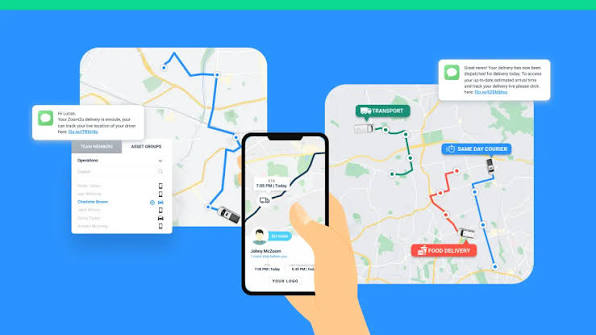
The dispatch layer of route mapping software shows each vehicle’s GPS position overlaid on its planned route path. Dispatchers can see at a glance which vehicles are on track, which are deviating, and which are significantly behind their planned progress. Deviation alerts are generated automatically when a vehicle departs from its planned path by more than a defined threshold.
This live map view is the operational control environment for the shift. It replaces the fragmented picture assembled from driver phone calls with a continuous, accurate visual feed of the full fleet’s performance against plan.
Real-time Map Updates During Execution
Route mapping software connected to live traffic data updates navigation instructions as road conditions change during the shift. A traffic incident on a planned road segment triggers an alternative route calculation. The driver receives updated navigation instructions before reaching the affected section. ETA recalculations for downstream stops are propagated immediately to the dispatch visibility layer and the customer notification system.
This real-time responsiveness is the mechanism that prevents traffic incidents from cascading into missed customer windows. The plan adapts to conditions as they develop rather than requiring manual intervention to salvage a shift that has been disrupted by static routing.
Execution Data Feeding Back Into Planning
Route mapping software generates a continuous stream of execution data: actual arrival times at each stop, actual dwell durations, navigation path deviations, and exception records. This data is the feedback loop that improves future planning accuracy.
Actual dwell times at specific customers reveal service time patterns that planning models can incorporate. Navigation deviations at specific locations reveal access point errors that can be corrected in the mapping layer. Traffic-driven delay patterns in specific corridors and time combinations inform future route-building decisions.
Operations that close this feedback loop systematically using execution data to improve planning inputs see route plan accuracy improve with each passing month. The mapping software that drives execution today is also building the data foundation that makes tomorrow’s plans more reliable.
From Plan to Delivery With Precision
The quality of last-mile delivery execution depends on how well the plan is translated into driver action and how accurately execution is monitored against the plan. Route mapping software is the technology that makes this translation precise, visible, and continuously improving.
Technology partners like FarrEye close the loop between plan and delivery, giving drivers accurate guidance and dispatchers live visibility across every shift. You can also explore their AI agent PILOT to see how plan-to-execution translation works in your operation.





Be First to Comment