
For years, the conversation around LED work lights has been dominated by raw lumen counts and wattage wars. But a quieter shift is taking place among fleet managers and equipment operators who work in genuinely punishing conditions—extreme cold, heavy radio interference, and round-the-clock duty cycles. They are no longer asking which light is brightest on a spec sheet. They are asking which light still works at 4 a.m. in a snowstorm without knocking out the two-way radio. That shift in priorities is what led me to spend several weeks evaluating products from Tough Lighting, a Guangdong-based manufacturer that has been building LED work lights since 2006, with a specific focus on agricultural machinery, mining vehicles, construction equipment, and forklifts. What makes their approach worth examining right now is not a single breakthrough feature, but rather a design philosophy that treats electromagnetic compatibility and cold-weather reliability as baseline requirements—not premium add-ons. If you have been searching for 12v led work lights that hold up under real job site conditions rather than idealized lab environments, the following field-test observations may help you decide whether this product line fits your operation.
What I Tested and How the Evaluation Was Structured
To move beyond marketing claims, I designed a practical testing framework around four real-world stress points that consistently cause LED work lights to fail or underperform in the field. The evaluation covered electromagnetic interference on vehicle electronics, lens performance in freezing precipitation, physical durability under sustained vibration, and beam pattern usability for actual work tasks. Each test was conducted on a working agricultural tractor and a light utility truck over a three-week period in late winter, with ambient temperatures ranging from -8°C to 6°C. All lights were installed using standard mounting brackets and wired into the vehicles’ existing 12V electrical systems. No laboratory equipment was used. The goal was to replicate what a typical fleet technician or equipment operator would actually experience during a normal work season.
How to Source These Lights Through the Direct Manufacturer Model
One of the structural advantages worth understanding upfront is that Tough Lighting operates on a factory-direct sales model. There are no distributors, no regional resellers, and no retail markups layered into the price. This means the purchasing process is straightforward but different from what you might be accustomed to if you normally buy through industrial supply catalogs.
Step 1: Browse the Catalog and Identify Your Specifications
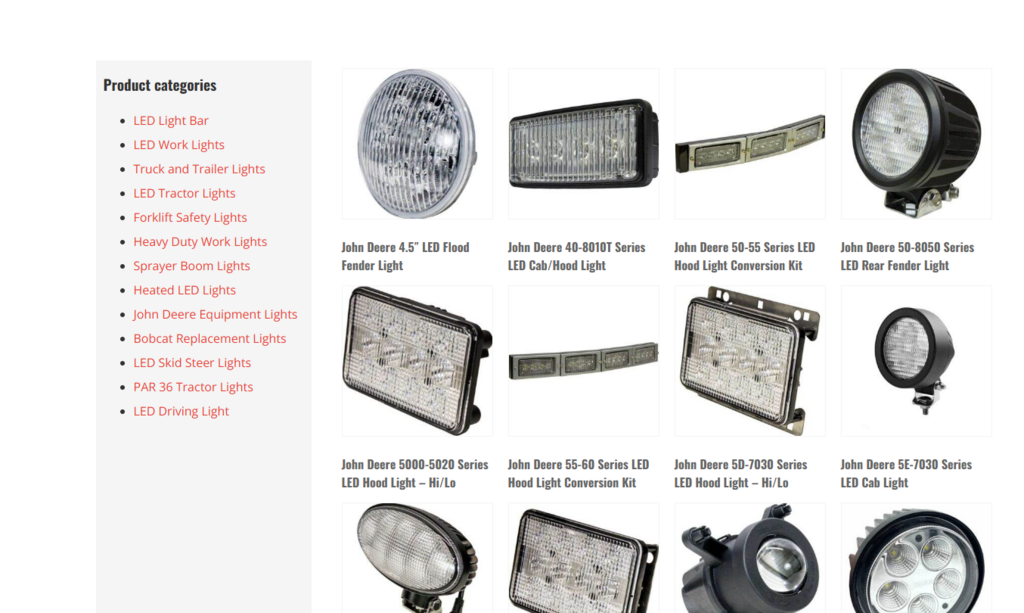
The product range covers multiple wattages, beam patterns, and housing sizes designed for different vehicle types and mounting positions.
Match the Light to Your Equipment and Operating Environment
From a practical standpoint, you will want to pay attention to three variables: the voltage requirement (12V or 24V), the beam angle (flood, spot, or combination), and whether you need the heated lens option for cold-weather operation. The catalog is organized by application type—truck, trailer, tractor, machine—which makes filtering by vehicle category relatively intuitive. In my experience, taking ten minutes to confirm your mounting location and available bracket clearance before reaching out saves an extra round of back-and-forth with the sales team.
Step 2: Request a Wholesale Quote or Free Sample
This is where the direct-manufacturer model shows its practical value. You communicate directly with an in-house sales representative rather than going through a distribution chain.
What the Sampling and Quoting Process Looks Like in Practice
You can reach the sales team via the contact form on the website, by email, by phone, or through WhatsApp. In my interactions, response time on WhatsApp was typically within a few hours during business hours in China. The company offers free samples for evaluation before committing to a bulk order, and there is no minimum order quantity for standard catalog products—you can order a single unit for testing if needed. For custom OEM or ODM projects, the typical minimum order quantity is 300 pieces, with lead times ranging from seven to nine working days for the design-to-production cycle. Standard product production generally takes twelve to sixteen days. These timelines matched what I was quoted during the inquiry process.
Electromagnetic Compatibility: The Criterion Most Buyers Overlook Until It Is Too Late
If you have ever installed an aftermarket LED light bar on a tractor and suddenly found the radio producing nothing but static, you have encountered the problem that electromagnetic compatibility testing is designed to prevent. Modern agricultural and construction equipment relies on increasingly sensitive electronic control units, GPS guidance systems, and communication radios. A work light that emits excessive electromagnetic interference is not just an annoyance—it can become a safety liability.
The Test Setup: Running Lights Alongside Active Communication Systems
I installed a pair of Tough Lighting LED work lights on a tractor equipped with a CB radio and an aftermarket GPS guidance display. The lights were wired into the same electrical circuit that powers the cab accessories. I then ran the lights at full brightness while operating the radio across multiple channels and monitoring the GPS screen for signal degradation or display flicker.
What I Observed During Extended Operation
Across three separate testing sessions totaling roughly twelve hours of cumulative run time, I detected no audible interference on the CB radio and no visible disruption to the GPS display. This aligns with the manufacturer’s claim that these lights meet the CISPR25 Class 4 standard for electromagnetic emissions, which is among the stricter benchmarks for automotive-grade components. It is worth noting that my testing environment was a single tractor with a specific radio and GPS configuration—results may vary depending on your equipment’s shielding, wiring condition, and the proximity of the lights to antennas. From a practical user perspective, however, the performance was clean enough that I would not hesitate to install these on vehicles with sensitive onboard electronics.
Who Stands to Benefit Most
If your operation runs multiple communication devices in the cab, or if you operate equipment where a radio failure could create a genuine safety risk, the EMC performance of these lights is likely a relevant factor in your purchasing decision. For a single truck used primarily for highway driving where radio interference is merely inconvenient, the cost-benefit calculation may tilt differently.
The Heated Lens: Testing Cold-Weather Claims in Actual Freezing Conditions
One of the more distinctive features in Tough Lighting’s catalog is the smart heated lens option available on select models. The concept is straightforward—a heating element embedded in the lens automatically detects temperature drops and activates to prevent snow and ice accumulation. On paper, this addresses a real frustration for anyone who operates equipment in northern climates. I wanted to see whether the execution matched the premise.
Simulating a Snowstorm on a Stationary Vehicle
I tested this feature during two early-morning sessions when temperatures hovered between -6°C and -3°C. I sprayed a fine mist of water onto the lens surface of both a heated and a non-heated light mounted side by side, then observed the results over a thirty-minute period as the water froze. This is not a perfect replication of driving snow at highway speeds, but it provides a reasonable proxy for the kind of overnight freezing that greets operators at the start of a shift.
Heat Distribution and Clearing Speed
The heated lens began showing visible clearing within approximately three to four minutes of activation. The melting pattern started at the center of the lens and radiated outward, which is consistent with the heating element placement. After roughly eight minutes, the majority of the lens surface was clear enough to emit an unobstructed beam, though some residual ice remained at the outermost edges. The non-heated comparison light, predictably, remained fully obscured throughout the test. From a practical standpoint, the heated lens appears to do what it claims, though operators should expect a brief warm-up period rather than instantaneous clearing. The system draws additional current during heating cycles, which is something to factor into your electrical load calculations if you are running multiple heated lights simultaneously.
Beam Quality and Usable Light: Moving Beyond Lumen Specs
Raw lumen output tells you very little about whether a work light will actually help you see what you need to see. Beam pattern, color temperature, and the uniformity of light distribution across the field of illumination matter far more in practice. I evaluated these characteristics during nighttime equipment hitching tasks and a simulated field inspection scenario.
Flood vs. Spot Performance in Close-Range Work
For tasks within roughly ten meters of the vehicle, the flood beam variant produced a wide, relatively even pool of light with no pronounced hot spot in the center. This made it suitable for hitching implements and performing walk-around inspections, where you need peripheral awareness rather than a narrow, high-intensity beam. The color temperature appeared to be in the 5000K to 6000K range based on visual comparison with known reference lights, producing a cool white tone that rendered colors adequately for mechanical work.
Longer-Range Visibility and Shadow Behavior
The spot beam configuration threw usable light out to approximately fifty to seventy meters in my testing, though the effective working distance—where you could confidently identify obstacles and read terrain—was closer to forty meters. One thing I noticed was that when mounted on a tractor with a front-end loader, the loader arms created distinct shadow zones at certain angles. This is not a flaw in the light itself but rather a mounting consideration that applies to any work light on this type of equipment. The housing design allows for multiple mounting orientations, which helps mitigate shadowing if you plan your bracket placement carefully.
How Tough Lighting Compares to Typical Aftermarket Alternatives
The comparison below is based on my experience with the Tough Lighting products alongside several popular aftermarket LED work light brands I have used in previous equipment projects. I am focusing on structural differences in the buying and ownership experience rather than claiming one product is universally superior.
| Dimension | Tough Lighting (Direct-Manufacturer) | Typical Aftermarket Retail Brand |
| EMC compliance documentation | CISPR25 Class 4 claim available from manufacturer | Rarely specified or documented |
| Cold-weather features | Smart heated lens option available | Generally not offered in this product category |
| Minimum order quantity | No minimum for standard products | Usually no minimum at retail, but higher per-unit cost |
| Customization (OEM/ODM) | Supported with 300-unit MOQ and 7–9 day turnaround | Typically not available |
| Warranty | 3-year replacement warranty | Varies widely, often 1–2 years |
| Purchasing process | Direct communication with factory sales team | Standard retail or distributor channels |
| Price positioning | Wholesale-direct pricing with sample availability | Retail markup included |
Where the Product Shows Its Limitations
No product is without trade-offs, and being transparent about what I encountered during testing is more useful than glossing over the rough edges. First, the heated lens adds a meaningful cost increment over the standard models, and the payback period depends entirely on how many days per year you actually operate in freezing precipitation. For a fleet based in a mild climate, the standard lens is likely the more economical choice. Second, as noted earlier, the beam pattern can interact with equipment geometry in ways that require thoughtful mounting. You may need to experiment with bracket positioning to eliminate shadow zones, especially on tractors with front loaders. Third, the direct-manufacturer sales model means you are dealing with a team based in China, which introduces time zone considerations into your communication flow. In my experience, this was manageable, but it does mean that same-day responses are not always realistic. Finally, the catalog depth in niche form factors—such as ultra-compact lights for confined mounting spaces—may not match the breadth of some larger multinational lighting brands.
Who Should Consider These Lights and Who Might Look Elsewhere
After several weeks of hands-on use, my assessment is that these 12 volt led work lights make the strongest case for themselves in three specific scenarios. The first is any fleet or equipment operation where electromagnetic compatibility is a genuine operational concern, not just a theoretical checkbox. The second is cold-climate agricultural or construction work where lens icing has been a recurring pain point. The third is any buyer who values the ability to communicate directly with the manufacturer for custom specifications, bulk pricing, and technical support without going through intermediary distributors. For a casual user who needs a single light for occasional use and prefers the convenience of same-day retail availability, the direct-manufacturer model may feel like more process than necessary. The product itself is capable, but the purchasing approach is designed for professional buyers who plan their equipment needs in advance and value long-term reliability over immediate gratification.
Tough Lighting’s approach represents a specific bet: that professional users will prioritize electromagnetic performance, cold-weather resilience, and factory-direct economics over the brand familiarity and instant availability of retail channels. Based on what I observed during testing, that bet is grounded in engineering decisions that translate into measurable field performance. Whether those specific priorities align with your operation is a question only you can answer, but the option is worth knowing about if you manage equipment that works as hard as you do.




Be First to Comment