Here’s something most people don’t clock until they’ve driven an EV for a few weeks. The acceleration doesn’t just feel fast. It feels different. Immediate in a way that petrol cars aren’t, even quick ones.
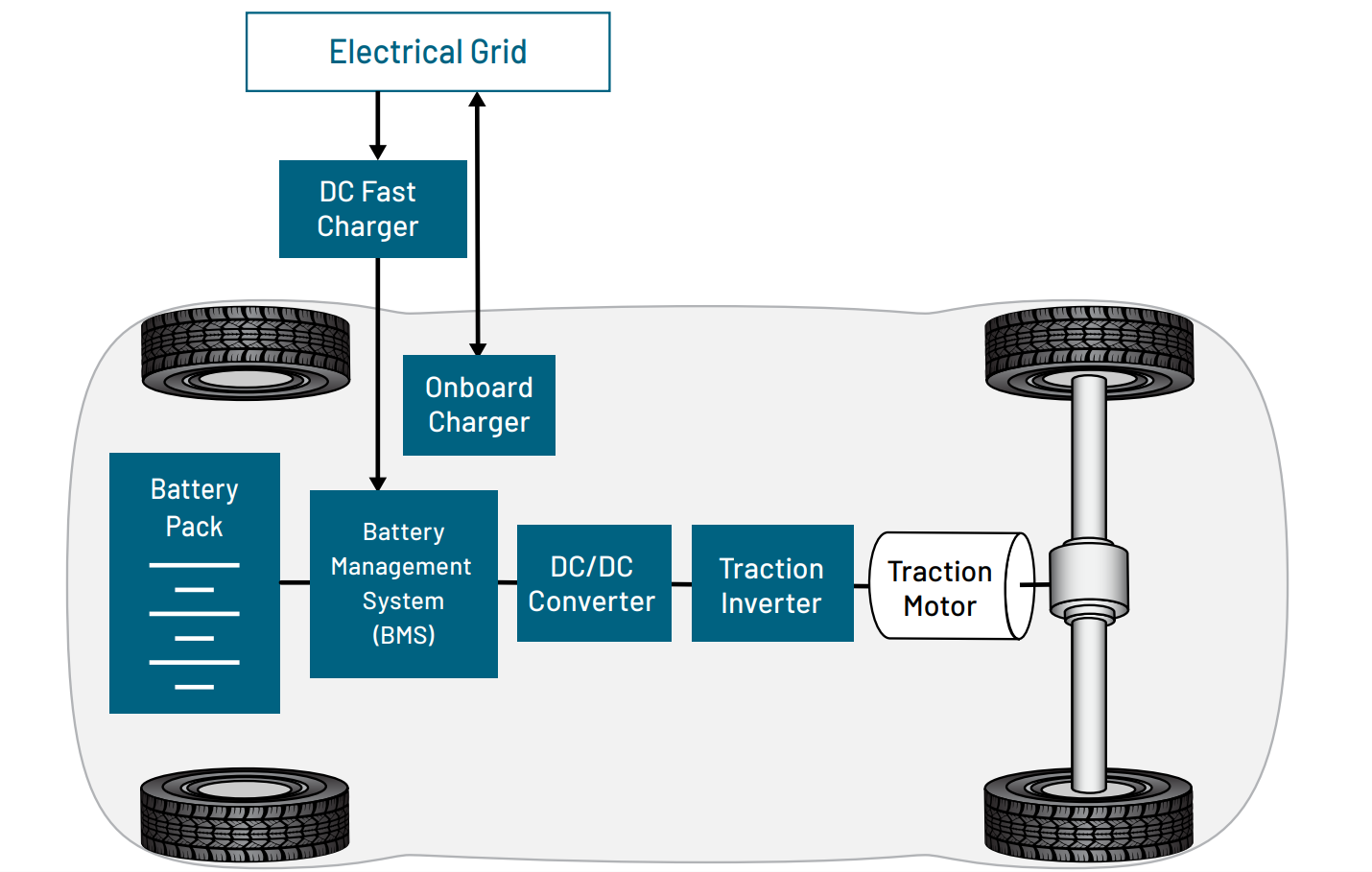
That feeling has a technical explanation. And it starts with understanding what’s actually inside an ev powertrain and why each component behaves the way it does under load.
The Motor: Torque Without the Wait
Two motor types dominate production EVs right now. Permanent Magnet Synchronous Motors (PMSMs) and Induction Motors (IMs). PMSMs are the more efficient choice at everyday speeds. Induction motors handle sustained high-speed output better. Neither is strictly superior.
Some manufacturers now run both on a single vehicle. PMSM on the rear axle for normal driving. IM on the front for when the extra grip is needed. It sounds like overkill until you understand what each type is bad at.
The thing that catches people off guard is time-to-torque. A combustion engine at idle has nearly zero torque available. It builds as revs rise. An electric motor at standstill already has its full torque on tap. Press the pedal and 280 Nm arrives before the car has moved a metre. That’s not a feature. That’s just how the physics works.
The Inverter: Nobody Buys an EV for This, But They Should Care
DC leaves the battery. AC enters the motor. Something converts one to the other, accurately, thousands of times per second, without turning into a heat source.
That something is the inverter. For years it was the quiet bottleneck nobody talked about.
Silicon IGBTs were the standard. They worked. They also ran hot, lost efficiency at higher switching speeds, and added thermal load to an already thermally complex system. Silicon Carbide MOSFETs changed the picture considerably. They switch faster, waste less energy, and stay cooler under sustained load. The U.S. Department of Energy puts the efficiency improvement at 5 to 10% over conventional silicon inverter designs.
On a vehicle you charge 300 times a year, that improvement is not theoretical. It shows up in your electricity bill and your range figure.
The Battery Pack: The Chemistry Debate Misses the Point
LFP versus NMC. The forums argue about this constantly. LFP cells run cooler, degrade more slowly, and tolerate aggressive charging better. NMC cells store more energy per kilogram, which is why range-focused vehicles still use them. Both have legitimate use cases.
What gets less attention is thermal management, and it probably matters more than cell chemistry in real-world longevity.
Lithium cells have a preferred operating window, roughly 15°C to 35°C. Outside that band, things go wrong slowly and then obviously. Range shrinks in January. Charge acceptance narrows. Cells at the edges of the pack age faster than cells in the centre. The ev powertrain sits on top of all this. If the cooling architecture doesn’t keep the pack uniform in temperature, the BMS is compensating for problems that shouldn’t exist.
The BMS: This Is What Actually Protects Your Battery
Nobody mentions the Battery Management System when they’re buying an EV. It doesn’t appear in brochures. It has no visual presence. It is, quietly, one of the most consequential pieces of engineering in the vehicle.
The BMS monitors individual cells, not just pack-level averages. Voltage. Temperature. State of charge. It balances cells during charging so no single cell hits its ceiling before its neighbours. It sets charge rate limits. It decides in real time how much current the pack can absorb from regenerative braking at this temperature, at this state of charge, right now.
Consider two vehicles with the same battery chemistry and the same capacity at purchase. At 180,000 km, one holds 87% of original capacity. The other is at 71%. Different BMS calibration, different thermal management decisions, different outcomes. The cells are not the variable. The management of the cells is.
Reduction Gears: The Simplest Part of the System
Petrol engines produce usable torque in a narrow rev band. That’s why they need five or six gears. Electric motors produce torque from nearly zero RPM to well beyond 10,000 RPM. One fixed gear ratio covers the entire range.
Most EVs use a single reduction gear, typically somewhere between 7:1 and 10:1. It steps motor speed down to wheel speed. No shifts, no clutch, no torque interruption during acceleration. The drivetrain mechanical losses are genuinely low.
Some performance vehicles are now testing two-speed setups for sharper top-end figures. Worth watching. For the majority of drivers on the majority of roads, the single-speed arrangement is already more capable than the situation ever demands.
Regenerative Braking: Energy the Old Way Just Threw Away
Friction brakes work by converting kinetic energy to heat. That heat disperses into the air and is gone. Every time a petrol car slows down, that’s energy that was paid for at the pump, burned in the engine, and then thrown away at the brake rotor.
Regenerative braking reverses that. The motor runs as a generator during deceleration. Kinetic energy becomes electrical energy. That electricity goes back into the battery.
Urban driving with regular stops typically returns 10 to 25% of energy used back into the pack. The practical side effect is brake wear. Many EV drivers are still on their original brake pads past 90,000 km, because friction braking becomes the backup rather than the primary system. One-pedal driving, where releasing the throttle provides most of the deceleration needed in traffic, feels odd for about three days and then becomes the only way you want to drive.
Integration Is the Variable Nobody Benchmarks
Here’s what spec sheets don’t capture. A well-specified motor mated to a poorly designed inverter loses efficiency at every power transfer. An excellent BMS protecting a pack with inadequate cooling is correcting for a problem that good thermal design would have prevented.
The ev powertrain isn’t a collection of independent components that can be evaluated in isolation. It’s a system. Motor, inverter, battery, BMS, thermal management — they interact constantly. Manufacturers that treated this as five separate engineering problems got five adequate solutions. The ones that designed across all five simultaneously got vehicles that still deliver close to original range figures at 200,000 km.
That’s the gap worth caring about. And it’s invisible until the odometer gets high enough to tell the truth.




Be First to Comment