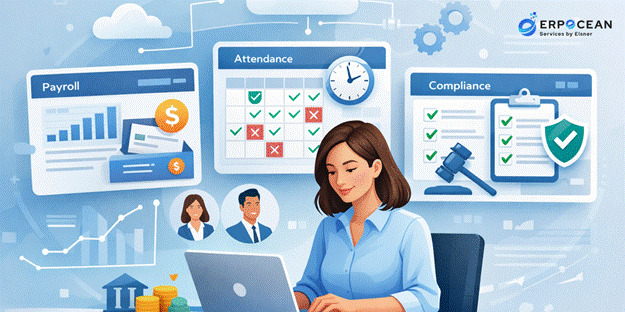
Managing people has never been simple, but in today’s fast-moving business environment, it has become significantly more complex. Organizations are expected to handle growing teams, diverse work models, evolving labor laws, and rising employee expectations, often with limited resources. Payroll accuracy, attendance tracking, and statutory compliance are no longer just back-office tasks; they are critical business functions that directly affect trust, productivity, and organizational stability, making the need for the Best payroll software more important than ever.
This is where HRMS (Human Resource Management System) solutions step in. By centralizing data and automating core HR operations, HRMS software transforms fragmented processes into streamlined workflows. Instead of juggling spreadsheets, emails, and disconnected tools, HR teams gain clarity, control, and confidence in managing their workforce.
This blog explores how HRMS software simplifies payroll, attendance, and compliance, and why it has become a foundational system for modern organizations.
The Challenge of Traditional HR Operations
Many businesses still rely on manual or semi-digital systems to manage HR activities. Payroll is processed using spreadsheets, attendance is tracked through registers or basic tools, and compliance is handled reactively, often just before deadlines. While this approach may work for small teams, it becomes unsustainable as organizations grow.
Manual payroll calculations increase the risk of errors, delays, and employee dissatisfaction. Attendance inconsistencies lead to disputes and inaccurate salary processing. Compliance failures can result in penalties, audits, and reputational damage. Together, these challenges place enormous pressure on HR teams and divert focus away from strategic initiatives such as talent development and workforce planning.
HRMS software addresses these issues by bringing structure, automation, and transparency to the entire employee lifecycle.
What Makes HRMS Software Essential Today
At its core, HRMS software is designed to act as a single source of truth for all employee-related information. From personal details and job roles to attendance records and salary structures, everything is stored and managed in one centralized system.
This centralization eliminates data silos and ensures that every HR process is connected. Attendance data feeds directly into payroll calculations. Leave approvals are automatically reflected in salary processing. Compliance reports are generated using real-time employee data. The result is a seamless flow of information that reduces manual intervention and improves accuracy.
As organizations embrace remote and hybrid work models, the need for such connected systems has become even more critical.
Simplifying Payroll Through Automation
Payroll is one of the most sensitive HR functions. Employees expect timely and accurate salaries, and even minor errors can erode trust. HRMS software simplifies payroll by automating calculations, standardizing processes, and ensuring consistency across pay cycles.
Salary components such as basic pay, allowances, incentives, and deductions are predefined within the system. Once attendance and leave data are finalized, payroll processing becomes a structured, predictable task rather than a monthly scramble. Tax deductions, statutory contributions, and reimbursements are calculated automatically based on configured rules.
By using reliable Payroll software, organizations can significantly reduce payroll errors, processing time, and dependency on manual checks, creating a smoother experience for both HR teams and employees.
Accuracy and Confidence with the Right Payroll Approach
One of the biggest advantages of HRMS-driven payroll is its ability to scale without increasing complexity. As employee numbers grow, the system handles higher volumes without compromising accuracy. Multi-location payroll, different salary structures, and varying compliance requirements can all be managed within the same framework.
For businesses aiming to deliver consistent and transparent salary processes, adopting the Best payroll software is not just about automation; it’s about building employee confidence and ensuring long-term operational stability.
Attendance Management Made Effortless
Attendance tracking plays a crucial role in payroll accuracy and workforce planning. Traditional methods often fail to capture real working hours, especially in flexible or remote environments. HRMS software introduces a structured approach to attendance by integrating digital tracking mechanisms with leave and shift management.
Employees can mark attendance through biometric devices, mobile applications, or web portals. Managers gain visibility into team availability, late arrivals, overtime, and absences. Approved leaves are automatically adjusted against attendance records, eliminating discrepancies during payroll processing.
This real-time visibility allows organizations to manage productivity more effectively while maintaining fairness and transparency across teams.
Leave, Shifts, and Workforce Visibility
Beyond basic attendance, HRMS platforms help organizations manage complex scheduling requirements. Shift planning, rotational schedules, and overtime policies can be configured according to business needs. Employees have access to self-service portals where they can apply for leave, view balances, and track approvals.
From a management perspective, this transforms HRMS into a broader Workforce management software solution, one that supports informed decision-making, efficient resource allocation, and proactive workforce planning.
Compliance Without Stress or Last-Minute Scrambles
Compliance is often one of the most underestimated challenges in HR operations. Labor laws, tax regulations, and statutory requirements evolve regularly, and non-compliance can lead to serious financial and legal consequences.
HRMS software simplifies compliance by embedding regulatory rules into payroll and employee management processes. Statutory deductions, contribution limits, and reporting formats are maintained within the system. Compliance reports can be generated instantly, ensuring accuracy and audit readiness.
By automating these tasks, HR teams move from reactive compliance management to a proactive, structured approach that minimizes risk and ensures peace of mind.
Transparency and Reporting for Better Decisions
Another major benefit of HRMS software is its reporting capability. Instead of manually compiling data from multiple sources, HR leaders can access real-time dashboards that present insights into payroll costs, attendance trends, leave patterns, and compliance status.
These insights support better budgeting, workforce planning, and policy evaluation. Leadership teams gain a clearer understanding of how people-related costs impact overall business performance, enabling more informed strategic decisions.
Understanding Cost and Value in HR Technology
When evaluating HRMS solutions, organizations often focus heavily on cost without fully considering long-term value. While HR software pricing varies based on features, scalability, and deployment models, the true return lies in efficiency gains, risk reduction, and improved employee experience.
By reducing manual workload, minimizing payroll errors, and ensuring compliance, HRMS software delivers measurable ROI over time. It also future-proofs HR operations, allowing businesses to adapt quickly to growth and regulatory changes without constant system overhauls.
HR Teams as Strategic Partners, Not Just Administrators
Automation fundamentally changes the role of HR teams. When repetitive tasks such as data entry, payroll calculations, and attendance reconciliation are handled by the system, HR professionals can focus on strategic initiatives.
Talent development, employee engagement, performance management, and organizational culture become priority areas. HRMS software supports this shift by providing reliable data and streamlined processes that free up time and mental bandwidth.
In this way, HRMS functions as a true HR automation software platform, one that empowers HR teams to contribute directly to business growth.
Choosing the Right HRMS Partner
Selecting the right HRMS solution is as much about the technology as it is about the implementation and support ecosystem. Organizations must assess their current challenges, future growth plans, and internal capabilities before making a decision.
A trusted partner like ERPOcean can help businesses align HRMS implementation with operational goals, ensuring that payroll, attendance, and compliance processes are optimized from day one. The right guidance ensures smoother adoption, faster ROI, and long-term success.
The Future of HR Operations
As businesses continue to evolve, HRMS software will play an even greater role in shaping organizational agility. Advanced analytics, AI-driven insights, and deeper integrations with business systems will further enhance HR decision-making.
What remains constant, however, is the need for accuracy, transparency, and compliance. HRMS software provides a strong foundation for these essentials, enabling organizations to manage their people with confidence and clarity.
Conclusion
Payroll, attendance, and compliance are not isolated HR tasks; they are interconnected processes that directly impact employee trust and organizational health. HRMS software brings these elements together into a unified system that simplifies operations, reduces risk, and supports strategic growth.
By embracing automation and centralized management, organizations can move beyond manual limitations and build HR processes that are efficient, scalable, and future-ready. In a world where people are a company’s greatest asset, investing in the right HRMS solution is no longer optional; it’s essential.
FAQs
1. Why do payroll errors keep happening even when we use spreadsheets or basic tools?
Payroll errors usually occur due to manual calculations, inconsistent attendance data, and last-minute changes in leaves or deductions. Spreadsheets lack validation, automation, and real-time syncing, which increases the chances of mistakes. An automated HRMS helps eliminate these issues by connecting attendance, leave, and payroll into a single system.
2. How can we manage attendance accurately for remote and hybrid employees?
Remote and hybrid teams often work flexible hours, making manual attendance tracking unreliable. HRMS systems allow digital attendance marking through web or mobile access, ensuring accurate records regardless of location. This also helps managers track productivity without micromanagement.
3. How do we choose the right HRMS implementation partner?
Choosing the right partner is critical for successful HRMS adoption. Look for experience, industry understanding, and post-implementation support. Partners like ERPOcean help businesses align HRMS solutions with real operational needs, ensuring smoother implementation and faster ROI.
4. Is HRMS software suitable for small and growing businesses?
Yes, HRMS software is highly beneficial for small and growing businesses because it scales with the organization. It reduces administrative workload, improves accuracy, and prepares businesses for future growth without needing frequent system changes.
5. How does HRMS reduce the workload on HR teams?
HRMS automates repetitive tasks such as payroll processing, attendance reconciliation, leave approvals, and report generation. This allows HR teams to focus more on employee engagement, talent development, and strategic planning rather than routine administrative work.



Be First to Comment